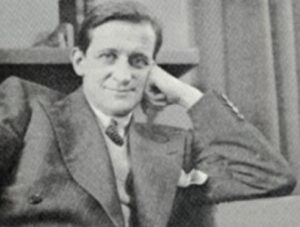
 Michael Myerberg (1906-1974) was a financier and producer who was the owner of the Mansfield Theatre, later renamed twice. He had a successful career on Broadway and was known for backing many serious plays to great success. He was elected to The Lambs in 1952 as a Professional member.
Mike Myerberg was born in Baltimore, August 5, 1906, to Nathan J. and Anna Myerberg, the middle of eight children. His older brother, Edward A. Myerberg, a Maryland real estate developer, joined The Lambs in 1958. Early in his career he managed jazz bands, produced acts for Vaudeville tours, and worked as a casting director for Flo Ziegfeld and the Shubert Brothers.
In the mid‐nineteen‐thirties he hit on the idea of a symphonic musical film and helped produce the soundtrack for “100 Men and a Girl,” with Deanna Durbin and conductor Leopold Stokowski. This gave Myerberg an idea.
Myerberg managed Stokowski, and in a one-page agreement, Myerberg produced him and the Philadelphia Symphony Orchestra for “Fantasia” in 1940. The Disney classic’s format and soundtrack is attributed to Myerberg, which decades after his death led to a series of lawsuits around royalty payments over videocassette profits. This was actually part of a long-running drama over the film. In the 1940s, Myerberg sued to recover fees for his role in securing financing for Walt Disney Productions, which included the financing that led to the production of “Fantasia.” A jury found in favor of Myerberg, awarding him $40,0000, a decision that was appealed by Disney. Myerberg prevailed.
In 1942, Mr. Myerberg produced Thornton Wilder’s Pulitzer Prize-winning drama, “The Skin of Our Teeth,” starring Fredric March, Florence Eldridge, and Tallulah Bankhead.
His subsequent shows included the national tour of Walter Kerr’s “Star Dust,” “Lute Song” with Mary Martin and Yul Brynner, “Dear Judas,” “The Cradle Will Rock,” Langston Hughes’s opera, “The Barrier,” and “Compulsion,” adapted from the novel by Meyer Levin.
In 1954, Myerberg produced his first TV film, the classic puppets on wires production of “Hansel and Gretel.” The film was groundbreaking for the visuals as well as the opera score, a first for the genre.
One of Myerberg’s career highs was trying to launch “Waiting for Godot” in 1955 with playwright Samuel Beckett. Myerberg produced the first American production, directed by Alan Schneider. Fellow Lamb Bert Lahr and Tom Ewell starred in the initial run. The opening of the tour was a disaster as the play was originally set to open in Washington and Philadelphia. However, low advance sales and bad weather forced the play to open in Miami for two weeks in January 1956 at the Coconut Grove Playhouse, where the audience was made up of snowbirds. It had been promoted as “the laugh sensation of two continents” in promotions run by Myerberg in the local media. Baffled audience members walked out. Taxi cabs waited by the doors to take walkouts back home. In 1956, The New Yorker profiled Myerberg in an uproarious “Talk of the Town” article.
Myerberg owned the Mansfield Theatre from 1945 until his death. The Chanins had lost the venue in foreclosure in 1933 and it remained mostly dark until 1945 when it was purchased by Myerberg, who leased it to CBS-TV until 1960. The venue returned to theatrical use and was renamed for Brooks Atkinson, the New York Times drama critic. In 1967, the Nederlander Organization took partial interest and bought the remainder from the Meyerberg estate in 1974. In 2022, they changed the name to the Lena Horne Theatre.
Myerberg partnered with Murray Kaufman (disc jockey “Murray the K”) to open discotheques in New York and Florida.
Michael Myerberg died in the Johns Hopkins Hospital in Baltimore on January 6, 1974. He was 67 years old. He was buried in Baltimore’s Hebrew Friendship Cemetery. Myerberg left a substantial collection of his papers to the University of Wisconsin-Madison.
Researched and written by Shepherd Kevin C. Fitzpatrick (2026)