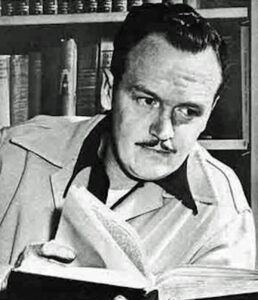
 Alexander Gillespie Raymond Jr. (October 2, 1909 – September 6, 1956) was an American cartoonist and illustrator best known for creating the Flash Gordon comic strip for King Features Syndicate in 1934. The strip was later adapted into numerous media, including three Universal movie serials (Flash Gordon in 1936, Flash Gordon’s Trip to Mars in 1938, and Flash Gordon Conquers the Universe in 1940), a 1950s television series, and a 1980 feature film. Raymond was elected to the Lambs in 1951.
Raymond was born in New Rochelle, New York, to Beatrice W. (née Crossley) and Alexander Gillespie Raymond Sr. Raised in the Roman Catholic faith, he showed artistic promise early on, encouraged by his father, a civil engineer who even displayed his son’s drawings on an office wall in the Woolworth Building. After his father’s death when Raymond was 12, he began to question the practicality of a career in art. He attended Iona Preparatory School on an athletic scholarship, where he played football.
He later worked as an order clerk on Wall Street before enrolling at the Grand Central School of Art following the 1929 economic downturn. Through connections with established cartoonists, he soon joined King Features Syndicate, where he would produce his most celebrated work.
In the early 1930s, Raymond began working as an assistant illustrator on strips such as Tillie the Toiler and Tim Tyler’s Luck. By the end of 1933, he created the epic science fiction strip Flash Gordon to compete with the popular Buck Rogers comic strip; it quickly surpassed its rival in popularity.
At the same time, Raymond worked on the jungle adventure Jungle Jim and the espionage strip Secret Agent X-9. However, the increasing workload led him to leave Secret Agent X-9 to another artist by 1935. In 1944, he joined the U.S. Marine Corps and served during the Second World War in the Pacific theater. After fulfilling his war duties, he returned to civilian life and created Rip Kirby, a highly acclaimed detective comic strip.
Often referred to as “the artist’s artist,” Raymond became renowned for his precise, clear, and highly influential style. Raymond’s influence on the comics industry was profound. Numerous artists—including Jack Kirby, Bob Kane, Russ Manning, and Al Williamson—cited him as an inspiration.
Filmmaker George Lucas also acknowledged Raymond’s Flash Gordon as a major influence on Star Wars. Raymond was inducted into the Will Eisner Comic Book Hall of Fame in 1996. Historian Maurice Horn described him as possessing “the most versatile talent” among comic strip creators, while others praised his style as “precise, clear, and incisive.” Cartoonist Carl Barks noted Raymond’s ability to combine craftsmanship with emotional depth and compelling storytelling.
On September 6, 1956, a month before his 47th birthday, Raymond was killed in an automobile accident in Westport, Connecticut. He was driving a 1956 Corvette owned by fellow cartoonist Stan Drake at approximately twice the posted 25 mph speed limit when the vehicle struck a tree. Raymond died instantly, while Drake was thrown from the car and survived. Although officially labeled an accident, for decades, armchair detectives and fans have speculated that the death may have been a suicide.
Raymond was buried at St. John’s Roman Catholic Cemetery in Darien, Connecticut. He was survived by his wife, Helen Frances Williams Raymond, and their son, Gabriel.
Raymond’s legacy remains immense. His innovative layouts, dramatic compositions, and refined line work helped define the visual language of adventure comic strips. His influence extended across generations, shaping not only comic art but also broader visual storytelling. Even decades after his death, his work continues to be studied, imitated, and admired.
Researched & Written by Lamb Bruce Roberts (2026)